So When Do I Need a Product Owner?
{this post continues a lively discussion we started with “Revenue products need Product Managers, not Product Owners” and continues with “How Do We Define Product Owners?” Comments and emails are flying furiously on this, so please post a comment below or link back to your own blog. – Rich Mironov}
Many Agile development teams think that they need a Product Owner for every project, but Product Owners address only a small portion of the Agile product management challenge. The role has bee artificially created by the Agile development community to focus on the hour-by-hour demands of an Agile team – even though software product companies have Product Manager and other existing resources to meet those needs.
This begs the question, though: assuming we have Agile Product Managers assigned to a revenue-focused product, do we ever need Product Owners? A thoughtful answer needs context, and must be based on the structure and talents of the team. Agile is scaling beyond single co-located teams and now includes revenue-driven product organizations – so let’s consider four situations:
1. Single, co-located Agile team: one Agile Product Manager can handle all of the demands from a product team that sits together. In fact, one Agile Product Manager should be able to manage two product teams in the same building – even factoring in travel, customer visits, and marketing/sales demands. At Enthiosys, we routinely (confidently) allocate 50% of an experienced APM to each development team. (Under waterfall, we’d expect on PM to handle up to 3 smaller products or projects.) IN OUR HUMBLE OPINION, when everyone sits together and the team is small, there’s no need for a separate Product Owner (or requirements analyst or business analyst) on the team to supplement the Agile Product Manager.
2. Larger co-located projects with multiple development teams: as products and projects grow, development has to create additional Agile teams. This is sometimes called the “scrum of scrums” approach, where one backlog is split out to three or more groups, each of which has a development manager, project manager (or scrum master), QA group, etc. The experience level of the APM matters here, as well as scale, team cohesiveness, and whether the different groups have radically different technical challenges. It’s critically important that one person (the Agile Product Manager) continues to be fully responsible for the resulting product and its revenue success, but it may be time to provide some help.
Most product companies already have a range of resources and talents to apply, so we might have a junior product manager (APMs-in-training) needing hands-on Agile experience under the guidance of a seasoned APM; business analysts and requirements analysts with intimate knowledge of the specific customer requirements; field sales engineers on loan for individual product releases; or someone formally designated at a Product Owner. In all cases, the Product Manager is delegating specific authority and is responsible for overall execution, coordination, priorities and customer satisfaction. Our Product Owner (by any name) is assigned to remove roadblocks, research questions, elaborate, clarify, motivate and assist – but to raise issues of substance back to the Agile Product Manager. So, Product Owners are optional for complex, co-located projects. Product Managers need to ask for help if they need it, and executives should to provide it.
3. Geographically distributed development teams. When development is split across time zones and continents, one product manager can’t possibly provide the face-to-face daily input and leadership that Agile demands. Even if the sub-projects are part of one product’s overall architecture – and one Agile Product Manager’s overall vision – you need leadership on the ground in each location to keep the work of Agile moving. This usually includes a development manager, a project manager (or scrum master), test/QA manager, and a Product Owner. (Here, the company will want to provide some formal training to similar resources such as business analysts, since they’ll be without much in-person guidance from their Agile Product Manager.)
Plane flights are too slow, phone calls too impersonal, and hour-by-hour task assignment changes posted to the walls of the War Room too complicated to manage at a distance. Having someone in each office and responsible for keeping the team clear on user stories/backlogs seems essential. As above, this quickly spins out of control unless the Product Owner (or equivalent) is tightly aligned with the remote Agile Product Manager, and quickly escalates issues that belong to the APM. So, a Product Owner (or equivalent) seems necessary for each remotely located development team.
4. My Product Manager isn’t doing a good job and doesn’t know Agile. Ask most Agile development managers in private, and this is what they really worry about. They are way ahead of their (non-Agile) product managers and are used to slow, second-hand, poor quality customer input. Hiring a Product Owner is one way of protecting the team from bad product management: “we still won’t have good market inputs or truly customer-driven backlogs, but at least we’ll manage our sprints well, and our developer-side collaboration will deliver something usable. We’re not sure that Product Management knows what it wants anyway.”
This situation is all about trust, skills, team-building, and managers being brave enough to say what they think. It should not be about creating another new title in order to cover for a failing PM. Coming back to our core beliefs as agilists (“We value individuals and interactions over processes and tools; collaboration over contract negotiation…”), development leadership and product management leadership need to step up with honest discussion like:
- “Our product managers don’t have any Agile training. Let’s get them all to class this month so we can stop complaining about it.”
- “We need more of a kick-start, especially since project timelines are at risk. Let’s bring in an outside Agile Product Manager for two or three iteration who can show us how It’s done while getting everything back on track.”
- “We all know that Product Manager X was barely competent doing waterfall, and is hopeless under Agile. Let’s replace him instead of spreading the load.”
- “Development doesn’t understand why Product Managers can’t be here at Headquarters every single day. Let’s give the dev team a half-day tutorial on what (else) Product Managers do, and why sitting at their desks every single day leads to inevitable strategic failure.”
- “Iteration Planning is always on Mondays and Retrospectives are always on Fridays. Can the APMs schedule more of their customer travel and sales briefings mid-week?”
- “Developers want to hear even more of what customers really say. If we promise not to say anything, can we sit in on your next few conference calls?”
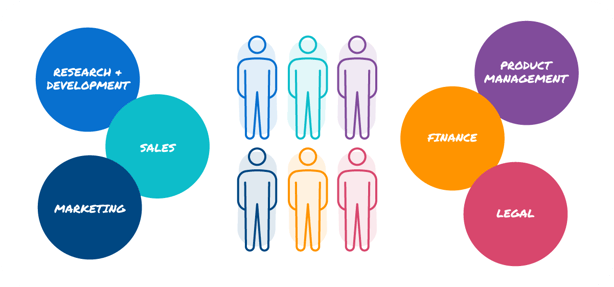
Product management veterans have seen similar reactions from other functional groups faced with weak PM teams. Marketing suddenly creates Product Marketing Managers for selected products instead of identifying the PM who’s unable to get his features/benefits straight. Finance invents a “pricing czar” to fill in for product manages who stumble through the pricing and packaging process without leadership or strategy. Developers freely interpret vague requirements and hope they build marketable software.
Said another way, Product Management is a very tough job, and we need to do it well. Creating Product Owners to cover our personal shortcomings or lack of Agile training is treating the wrong disease. Let’s make sure we’re doing our best Agile product management instead of meekly letting Development redefine our responsibilities. If we’re short of trained, capable Agile Product Managers, let’s get busy recruiting and mentoring and training to fill the real need.
So we ever need a Product Owner? Sometimes, in the right context and with distributed development teams that need real-time local help. But never staff up a revenue-driven product without a Product Manager and don’t assume that every Agile team needs a Product Owner.